

Tourist attraction
The Leontina Țăran House Museum in Ciocănești
Ciocănești
- Type
- Tourist attraction
- Locality
- Ciocănești
This is where it all started. Leontina Țăran married in 1942, at seventeen, and moved into her mother-in-law's house. Around 1950 she hired Dumitru Tomoioagă, a wood carver and house painter known in the village. Together they chose the pattern off her shirts and made the first pui on the wall of the house, then repeated it until the band came out.
The craftsman took on apprentices, and the neighbours put on their own walls the pattern they already had on the loom. The whole village of decorated houses comes from this one wall.
How the band is made
The plaster is cement, lime and sand. The pattern is laid on with a wooden stencil and cut with a chisel, then whitewashed and painted, so the marks are felt with the hand and not only seen. The local council kept the custom alive by giving villagers paint and cement, and a new house in the commune has to follow the local architecture.
The house museum
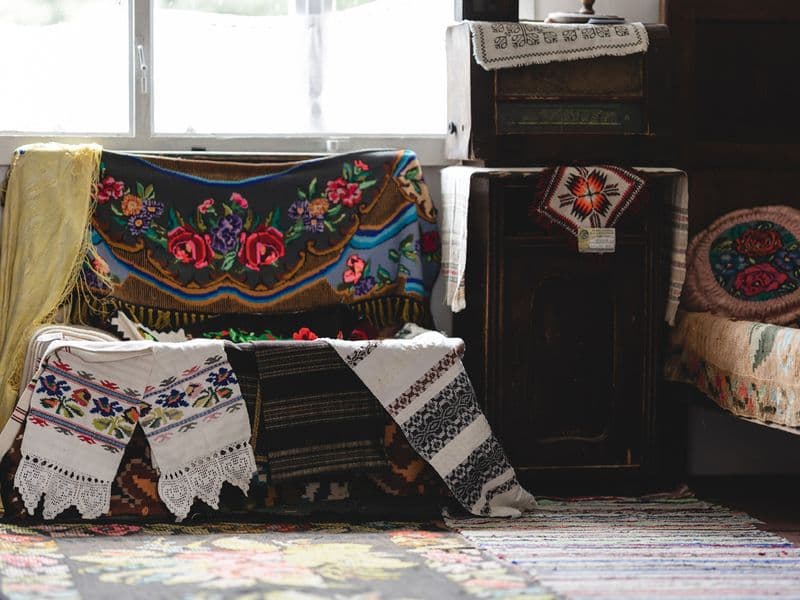
The house became a museum while Leontina was still alive, precisely because it had been the first. In 2014 the curators described it as two rooms of dowry: woven aprons, embroidered shirts, towels, carpets, rugs and pillows, all made by her own hand.
Leontina Țăran received visitors in her own house and told the story herself: they made one pui, then another, and so on until the band closed right around the wall.
Its standing as a museum came from that wall, not from a decision handed down. The rest of the village followed it.
What it looks like today
The house is one of the eight old farmsteads restored by 30 June 2026, so what you see now is not necessarily what stood there in 2014. The front is white, with a band of red-brown rhombs under the eaves and cross motifs on the walls; the porch has an orange wooden railing.
How to visit
There are no posted opening times and no ticket at the gate. The owners of the eight houses have undertaken to receive visitors for five years, but the simplest way is to ask at the town hall or at the ethnographic museum in the centre, on the DN18, when and where you can go in.
Ciocănești
Limite administrative UAT: ANCPI / INS · geo-spatial.org · CC BY-SA 4.0